Memoria
Memoria Web
Memoria Web is a browser tool for reading a Memoria store. Point it at a database, upload a zip of your own domain assemblies, and it shows you the events that were appended, the aggregates and projections snapshotted from them, and the types both were written through.
It is not a sample application and not a package. It lives in the repository at
src/Memoria.Web, and you
build and run it yourself — see Deployment.
- Configuration — the connection string, the provider, the Cosmos database and container, where uploads are kept
- Deployment — publishing it, hosting it, and what has to be true of the host
- Try it with sample data — a store filled in a couple of minutes, with no domain of your own needed
Why it needs your assemblies
A Memoria store holds serialised payloads under type bindings — OrderPlaced at version 1, an
aggregate under [AggregateType("Order")]. The bindings are names; the shapes they name live in
your assemblies. Without them the tool could list rows and nothing else: it could not say what an
event carries, fold a stream into an aggregate, or work out which snapshots a boundary should hold.
So the tool has no reference to any domain at all. You upload assemblies on the Settings page, it scans them for the types both consistency models declare, and registers what it finds:
| Model | Scanned for |
|---|---|
| Streamed | IStreamId, IAggregateRoot, IAggregateId, IProjection, IProjectionId, IEvent |
| DCB | IDcbAggregateRoot, IDcbAggregateId, IDcbProjection, IDcbProjectionId, IEvent |
Events are one bound set — an event is the same event whichever model appends it — so an event both models apply is counted under both.
The assemblies are read from bytes rather than from their path, and the registrations are rebuilt from scratch on every upload, removal and refresh. Nothing restarts, and a type you removed from a rebuilt assembly stops being offered rather than lingering from the previous load.
What it shows
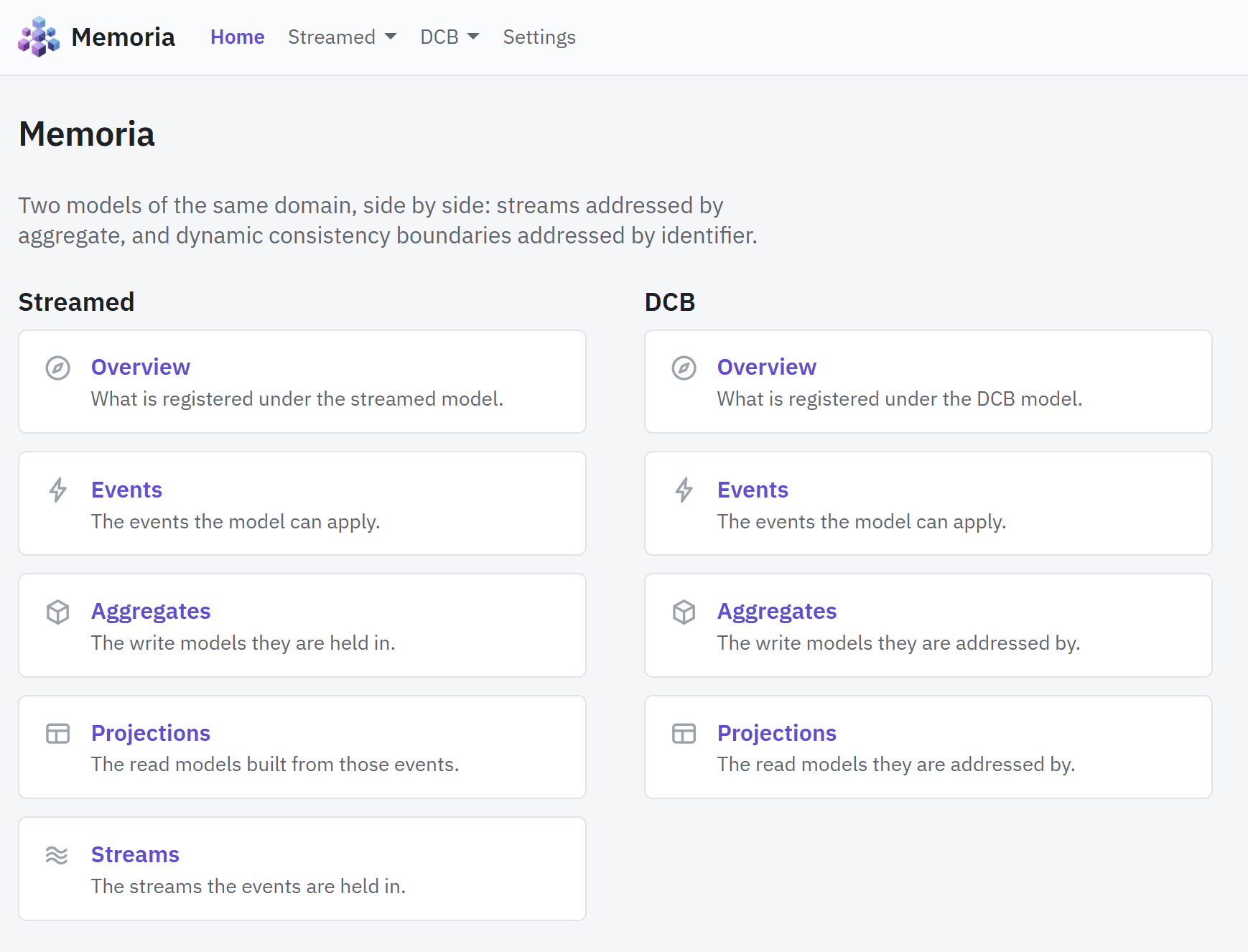
The two consistency models sit side by side from the home page, and each is laid out the same way:
- Overview — what is registered under that model, counted per section
- Events, Aggregates, Projections (and Streams, streamed only) — each a section with a Types page (what the uploaded assemblies declare) and a Data page (what the store holds)
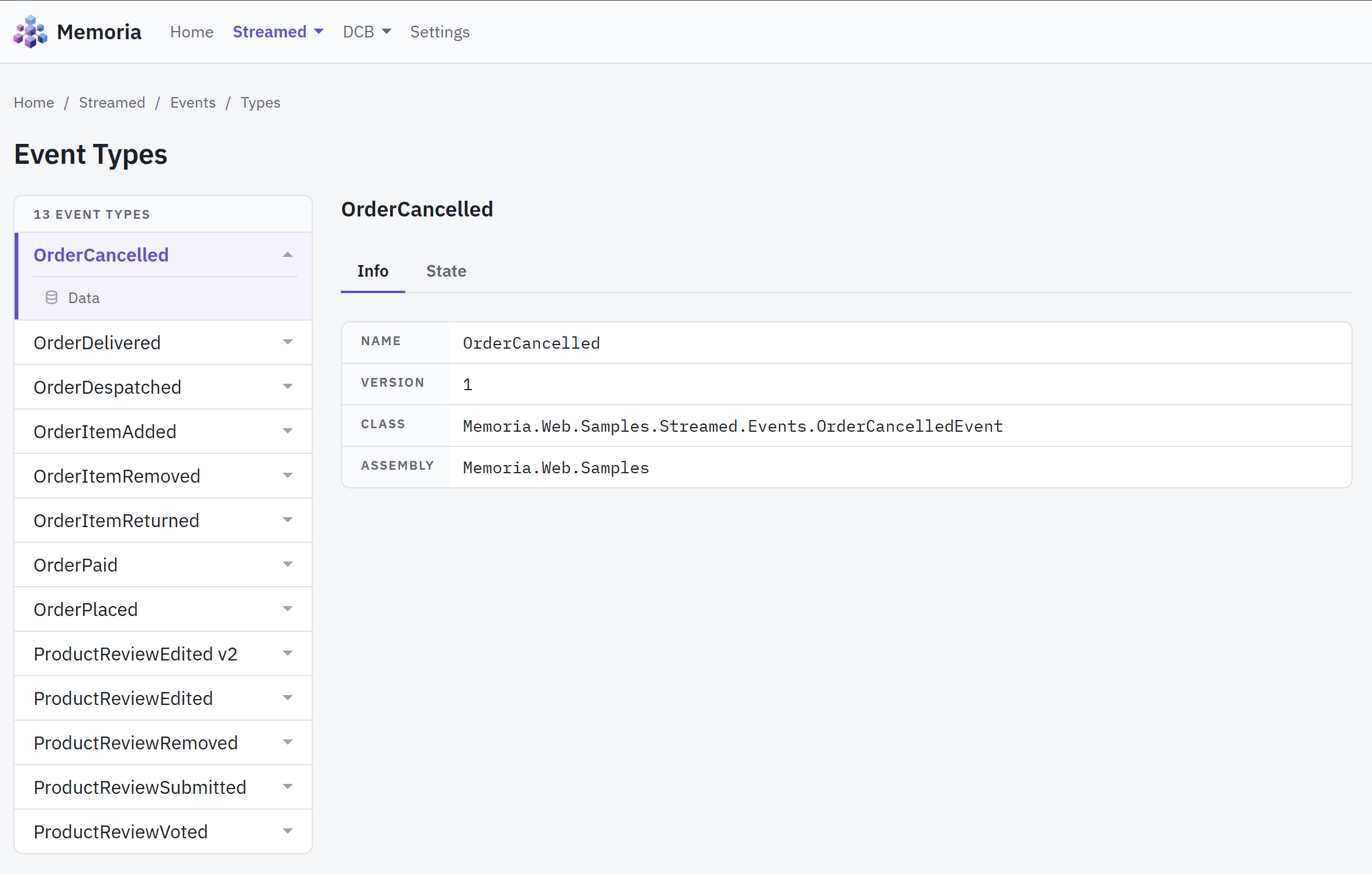
A Types page reads the registration rather than the store: what each type is bound as, at which version, and the assembly it came out of.
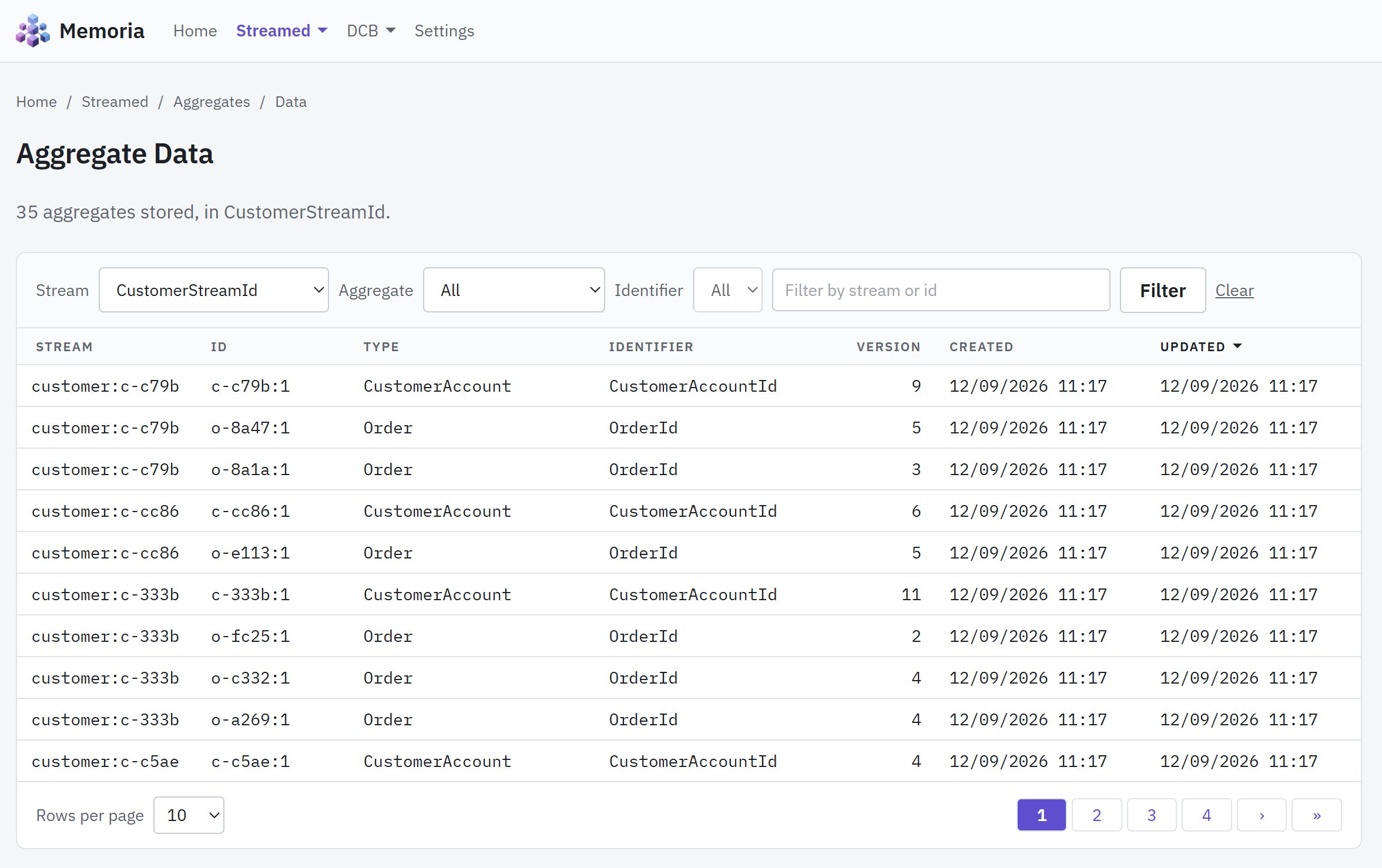
Data pages page, sort and filter, and every piece of that state — the filter, the sort, the page, the page size, which payloads are expanded — travels in the query string, so a view can be bookmarked, shared and stepped back through.
| Page | Narrowed by |
|---|---|
| Streamed → Events → Data | Stream, event type, and text in the payload |
| Streamed → Aggregates → Data | Aggregate type, identifier, and text |
| Streamed → Projections → Data | Projection type, identifier, and text |
| DCB → Events → Data | Event type, and text in the payload or in a tag |
| DCB → Aggregates → Data | Aggregate type, identifier, and text in a tag |
| DCB → Projections → Data | Projection type, identifier, and text in a tag |
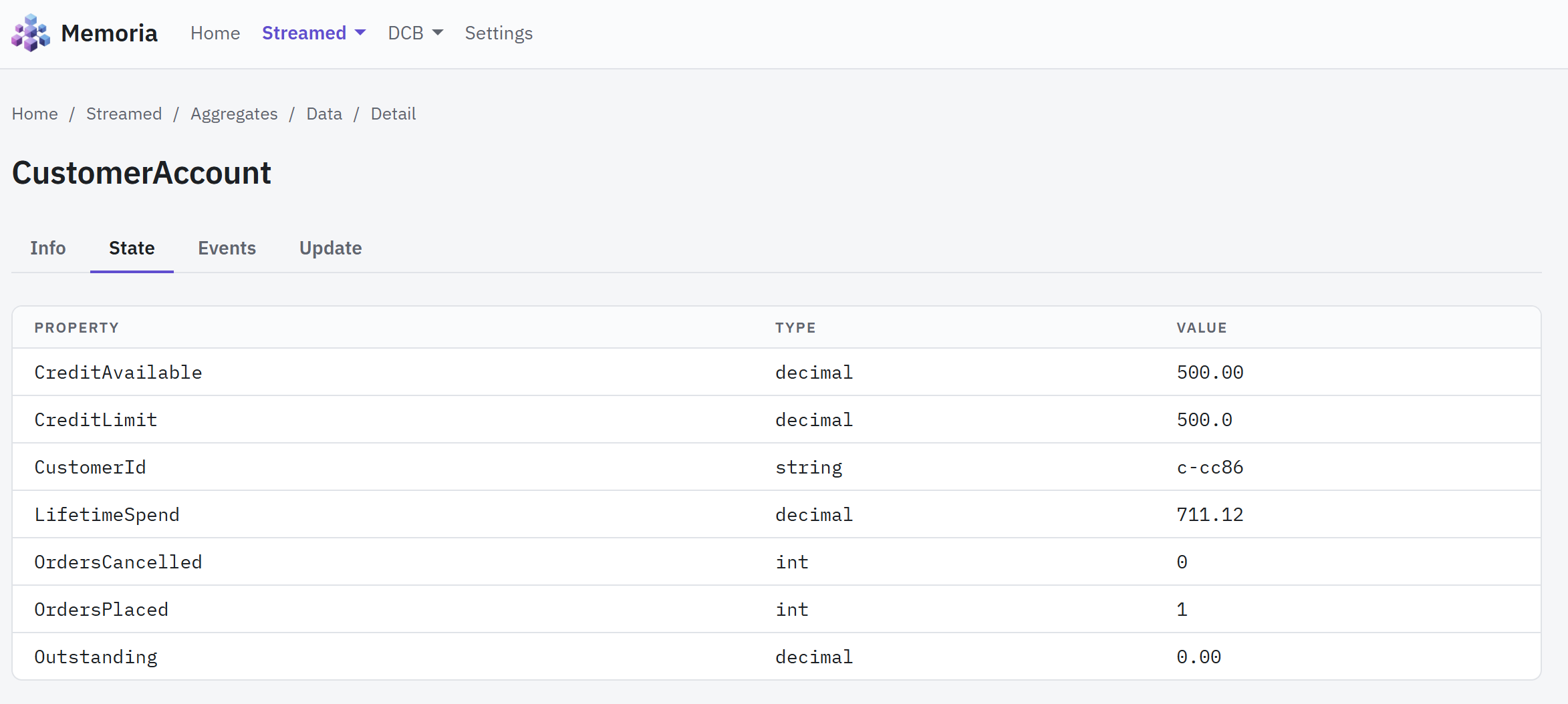
Opening a row reaches a detail page with five tabs: Info (how the row is identified and where its snapshot stands), State (the model folded), Json (the stored payload itself), Events (what it applied, or what its boundary holds), and Update.
State and Json show the same payload two ways. State reads it through the model’s own
properties; Json shows the text the store holds, laid out one value per line and coloured by kind,
in a box that scrolls once it grows past the screen. It is the row’s own text rather than the model
serialised again, so a payload the model cannot read back, or one carrying more than the model
declares, is still there to see — and a payload that is not JSON at all is shown as it is, under a
note saying why it could not be laid out. A Copy button above the box puts the laid-out text on
the clipboard; it appears only where the browser allows the page to write there, which means a
secure context: localhost or HTTPS.
The one thing it writes
Update refreshes a stored snapshot: the events the model has not applied yet are applied to it and the result is written back. That is the whole of it. The tool never appends an event, never deletes a row, and never creates a database, a container or a table — it opens what is already there, and a store whose schema is missing is an error the page reports rather than something it installs.
A snapshot that is already current, and a model with nothing to fold, both say so and write nothing.
What each store answers
| Engine | Streamed | DCB | Notes |
|---|---|---|---|
| PostgreSQL | ✅ | ✅ | Read through Entity Framework Core |
| SQL Server | ✅ | ✅ | Read through Entity Framework Core |
| SQLite | ✅ | ✅ | Against a file; an in-memory database is refused |
| Cosmos DB | ✅ | ❌ | Read through the Cosmos SDK, the way the store writes it |
There is no Cosmos DB store for dynamic consistency boundaries, and the model would not build on that provider if there were — see Providers. Under a Cosmos store the DCB menu is not shown and its addresses answer 404, so a bookmark says the same thing the menu does.
Cosmos also cannot fully order a page of results, and falls back to ordering by date alone: every row is there, but rows written at the same moment can move between pages. Pages under that store say so, and the note can be turned off under Settings → Preferences.
Everyone shares one set of types
Type registration lives in Memoria’s process-wide bindings, so one person’s upload, removal or refresh changes what every user of that server resolves. There is no push: other people’s open pages catch up when the browser is reloaded. The Settings page says this under both tabs that can cause it.
Browser preferences — theme, rows per page, whether the ordering note is shown — are the exception. They are stored in the browser and the server is never told.
Security
The tool has no authentication or authorization today, and uploading is running code. Anyone who can reach
/settingscan upload a.dllthat this process will load and execute. There is no login, no role, and no restriction on what an uploaded assembly may do. Both are planned for the next release; everything below describes the tool as it stands.
Authentication and authorization are coming in the next release. Until they land, the tool has no notion of a user at all: every visitor can read every page and press every button, including the ones that change what everyone else resolves. Plan for that rather than around it.
So for now, run it on localhost, or on a network where everyone who can reach it is already trusted with the store it is pointed at. Do not expose it to the internet. If you must, put authentication in front of it — a reverse proxy that requires a login before any request reaches the application — and treat upload rights as equivalent to shell access on the host.
Two more things worth knowing before pointing it at anything that matters:
- The connection string is the tool’s whole authority. Give it a read-only account unless you intend to use Update, which needs to write snapshots.
- Uploaded archives persist. They are kept on disk under the extensions directory and read again at the next start-up — see Configuration.
Requirements
- .NET 10 SDK to build it, or the ASP.NET Core 10 runtime to run a published build
- A store created by Memoria 1.9.0. The tool reads today’s schema —
DomainEvents,DomainAggregates,DomainProjectionsand the fourDcb*tables — so a database from an earlier version needs its upgrade applied first - Assemblies compiled against the same Memoria version the tool was built from. One built against an earlier version still loads, then contributes no types at all, and the Settings page reports the load error